
Buffered magnesium glycinate: is yours padded out?
Buffered magnesium glycinate is glycinate padded out with a denser, lower-cost form, usually magnesium oxide.
Illustrative label, not a real product. 31s.
No oxide in oursRecuperol Clean Magnesium Glycinate 3-in-1, £9.995 of 5top magnesium glycinate products on TikTok Shop UK do the same.By units sold in the 28 days to 16 October 2026 (FastMoss estimates).
55 of 80UK magnesium glycinate products whose labels we could check do the same.We checked 104. Another 24 don't give enough to tell.
Padding makes the label number bigger, but magnesium oxide is poorly absorbed. Two numbers and the ingredients list on the back of the pack tell you which you have.
Ours isn't padded out. Recuperol Clean Magnesium Glycinate 3-in-1 contains no magnesium oxide. Three capsules give 288mg of magnesium (77% NRV) from 2,100mg of magnesium bisglycinate, malate and citrate, which is 13.7%, under the 14.1% that pure glycinate can hold. Shop Recuperol Clean Magnesium Glycinate 3-in-1, £9.99
What does the video say?
Word for word. Tap a time to jump to that part of the video.
- 0:00How to tell what magnesium you're buyingHow to tell you're buying magnesium that your body can actually absorb.
- 0:04Padded out with magnesium oxideMost magnesium says glycinate on the front, but a lot of it is padded out with magnesium oxide, which is cheap and poorly absorbed.
- 0:10The two numbers to checkSo turn your pack over and look at two numbers: the total magnesium compounds and the elemental magnesium.
- 0:16The 14% limit for glycinateGlycinate, for example, cannot be more than 14% magnesium, so when it's claimed that it's 20%, the rest must be magnesium oxide.
- 0:23No oxide in oursOurs contains no oxide, just third-party tested magnesium that your body can actually absorb.
The precise version
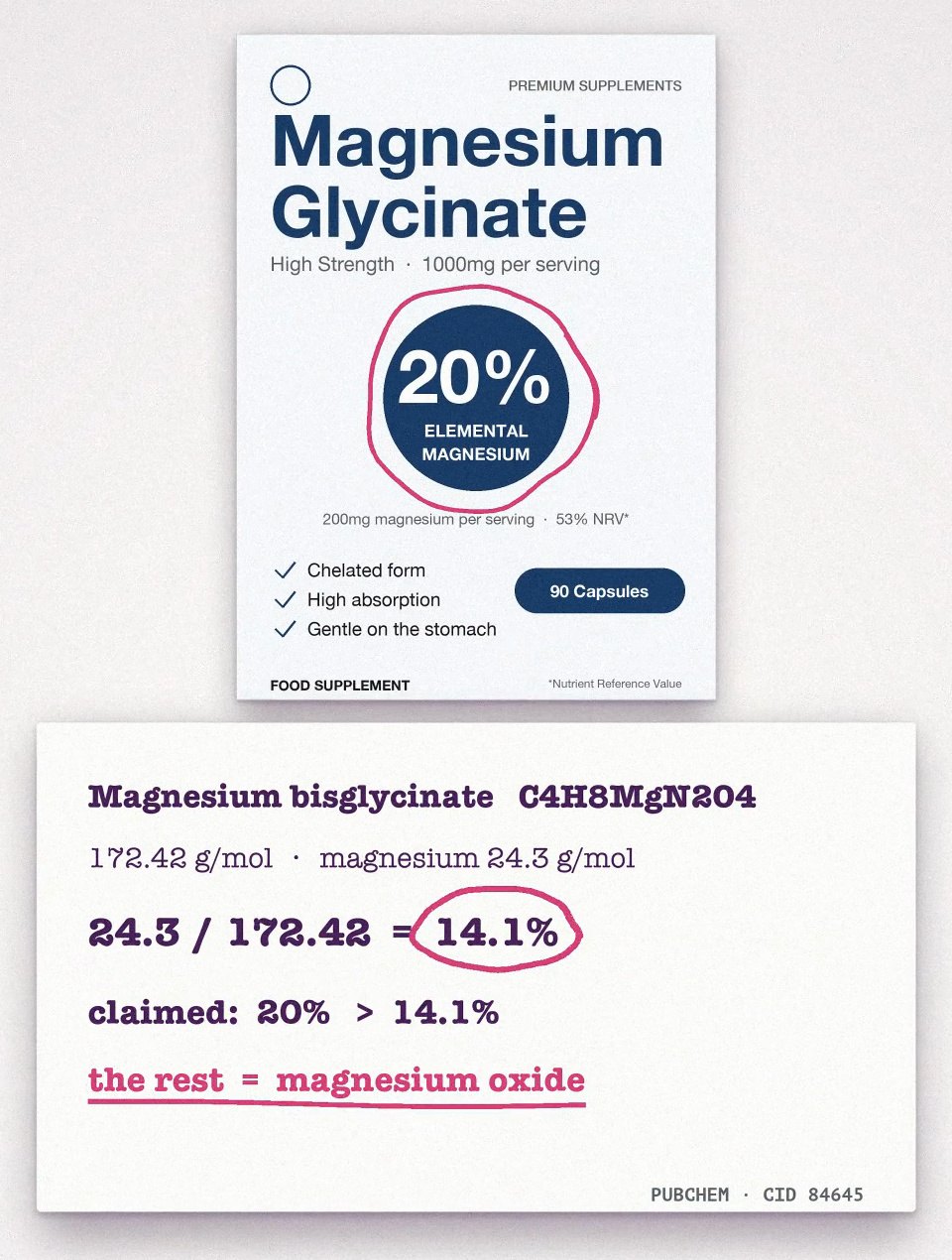
Pure magnesium glycinate tops out at 14.1% magnesium.1 If a glycinate pack works out at 20%, the extra magnesium has to come from a denser form. That's usually magnesium oxide; other denser forms, such as magnesium hydroxide, are also permitted.13 Either way, it isn't all glycinate.
What does elemental magnesium mean?
In a supplement, magnesium is always bound to something else.13 In magnesium glycinate, each magnesium is held by two glycines, and the glycines are most of the weight.1,5
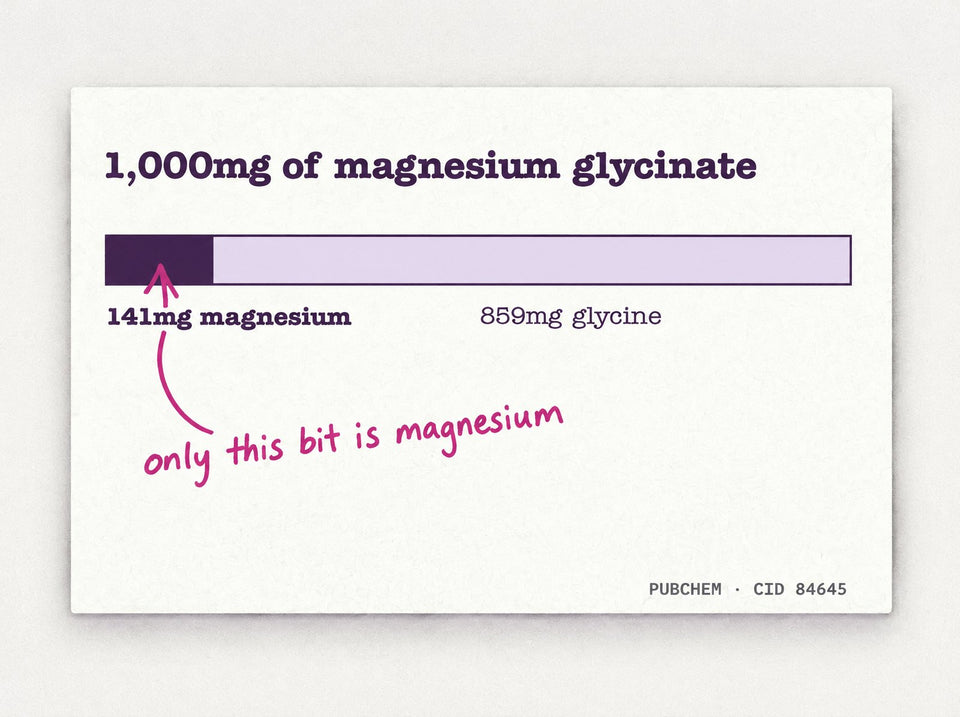
So 1,000mg of magnesium glycinate holds only about 141mg of magnesium. The rest is glycine. That 141mg is the elemental magnesium: the magnesium itself, and the figure printed with a %NRV on the back of the pack.1,11
Dashed line: the most pure glycinate can be, 14.1%
How do you tell if magnesium glycinate is buffered?
Divide the magnesium by the magnesium compounds on the back of the pack. If glycinate is the only form listed, the answer can't be above 14.1%, so a label that works out at 18% or 20% either has a denser form such as magnesium oxide in it or has the wrong figure on it. For a blend, check each form against the table below.
-
Turn the pack over
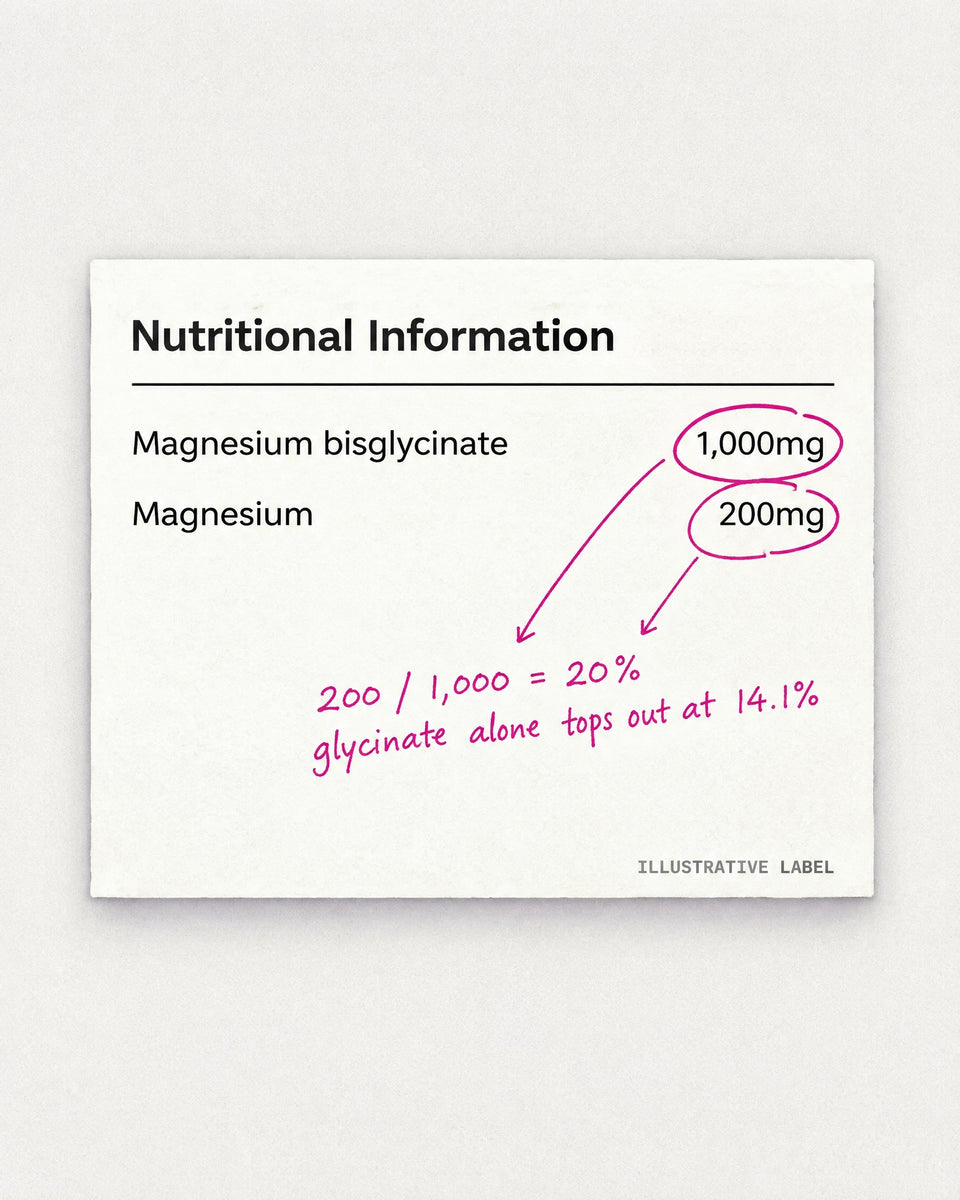
In the nutrition table, find two numbers per daily dose: the weight of the magnesium compound (for example, magnesium bisglycinate 1,000mg) and the magnesium itself, often called elemental magnesium, with a %NRV next to it.11
-
Divide one by the other
Magnesium divided by compound. 200mg of magnesium from 1,000mg of glycinate is 20%.
Illustrative label, not a real product. -
Compare it with the limit
Glycinate on its own is about 14% at most. Mixed with citrate or malate, usually up to about 16%. Around 18% or more means a denser form is in there, usually magnesium oxide, or the label figure is wrong.1,2
-
Read the ingredients
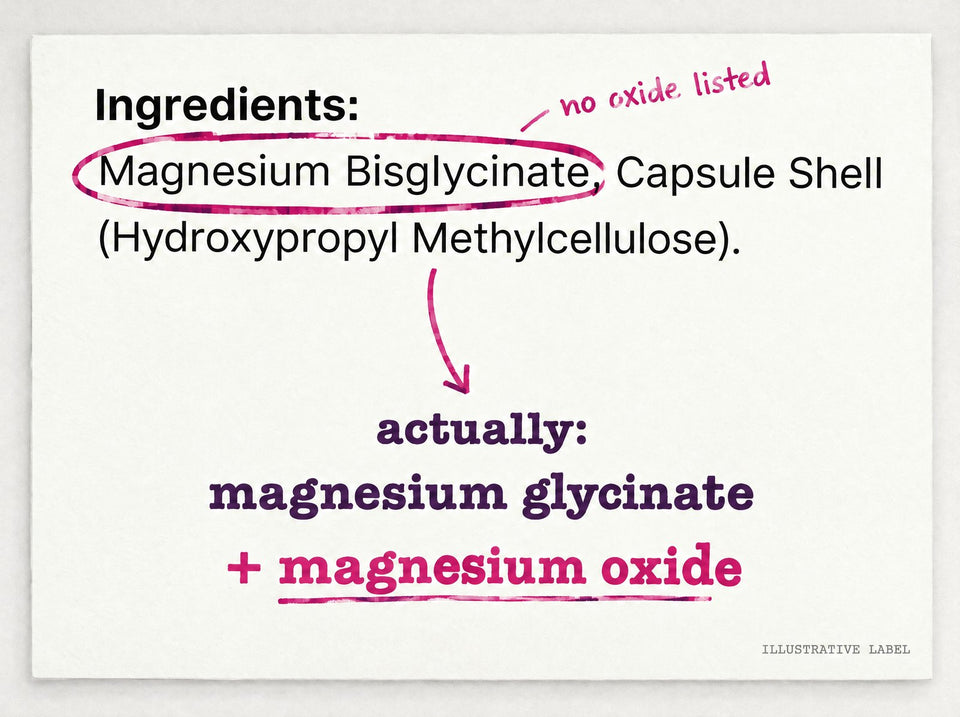
Look for magnesium oxide, hydroxide or carbonate, or the word buffered. UK law says every ingredient must be listed, in order of weight.12 But a denser form isn't always named: in our check, 22 products named none, yet claimed more magnesium than the forms they list can hold.14 Either a denser form is in there or the label's numbers are wrong. So if your number came out high in step 3, don't let a list that only says glycinate reassure you. No compound weight on the pack? Skip straight to this step.
Illustrative label, not a real product.
What is buffered magnesium glycinate?
Buffered means padded out. The glycinate is topped up with a denser, low-cost form, usually magnesium oxide, so the label can show more magnesium than glycinate alone could give. A denser form is one that packs more magnesium into each gram.2,5
Think of orange juice topped up with apple juice. The carton still says orange, and it's fuller, but not all of it is orange.
One ingredient maker sells both kinds. In its 2015 catalogue, its plain magnesium bisglycinate was listed at 10% magnesium and its buffered one at 18%, made with an additional excess of magnesium oxide
.5 On our sums, about half the magnesium in that buffered powder is oxide, not glycinate.*
Take a glycinate sold as 20% magnesium. Oxide is only about 13% to 20% of the powder, but because oxide is about 60% magnesium, it supplies roughly 40% to 60% of the magnesium.*
Why oxide matters
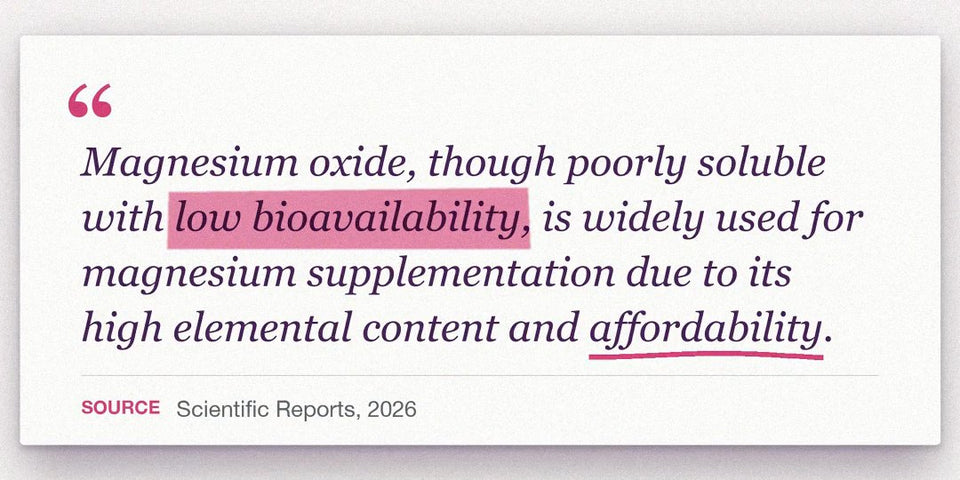
Oxide is a denser form: about 60% magnesium, against about 14% for glycinate. It packs more magnesium into each capsule, but it's poorly absorbed.8,10 It barely dissolves in water,7 and studies estimate that only about 4% to 10% of it is absorbed.10,8 In a 60-day trial in 46 healthy people, those given 300mg of magnesium a day as oxide did no better than those on a placebo, on the magnesium measured in their urine, blood and saliva.9 It is a permitted form in the UK,13 and results also depend on how a supplement is made, so we show you the numbers rather than promise an absorption figure.8
How common is it? Of the top 20 magnesium glycinate products on Amazon UK, 17 are padded out or claim more magnesium than their ingredients can hold. See how we checked.
| Form | Magnesium |
|---|---|
| Magnesium bisglycinate (glycinate) | 14.1% |
| Magnesium malate | 15.5% |
| Magnesium citrate | 16.2% |
| Magnesium carbonate | 28.8% |
| Magnesium hydroxide | 41.7% |
| Magnesium oxide | 60.3% |
Pure, dry forms, worked out from molecular weights.1,2 Real ingredients can come in lower.
What about magnesium stearate or rice flour?
Lots of capsules contain a little of something that isn't magnesium. Magnesium stearate (on labels: magnesium salts of fatty acids, or E470b) stops the powder sticking to the filling machine.18 Rice flour is an ordinary food, used to help capsules fill evenly. In the small amounts used, these are normal. Magnesium stearate is an approved food additive in the UK,20 and Europe's food safety authority found it of no safety concern
at the levels used.19 Neither one pads out the magnesium number: magnesium stearate is only about 4% magnesium.2
So that's not what we mean by padded out. Padding is about the form of magnesium. In our check, 9 of the 25 products that add up contain an ingredient like these, while at least 14 of the 55 that are padded out or claim more than they can hold list none.14 Recuperol's 3-in-1 happens to contain neither. If a product does need one, it has to appear in the ingredients list, like every other ingredient.12
Is Recuperol Clean Magnesium buffered?
No. Recuperol Clean Magnesium Glycinate 3-in-1 contains no magnesium oxide and no buffers: 3 capsules give 288mg of magnesium (77% NRV) from 2,100mg of magnesium bisglycinate, malate and citrate, which is 13.7%, under the 14.1% that pure glycinate can hold. Here are the same two numbers, straight from our label.16
| Magnesium bisglycinate (13% magnesium) | 1,050mg |
|---|---|
| Magnesium malate (14% magnesium) | 525mg |
| Magnesium citrate (15% magnesium) | 525mg |
| Magnesium compounds | 2,100mg |
| Elemental magnesium | 288mg (77% NRV) |
Under the 14% line, and no oxide in the ingredients list, because there isn't any.
Three forms, no oxide
Magnesium bisglycinate, malate and citrate. No magnesium oxide and no buffers. The NIH says citrate is generally absorbed better than oxide.6
Four ingredients
Those three, plus a plant-based capsule shell. Nothing else.
Ingredients tested by Eurofins
An independent lab measured a batch of our glycinate ingredient at 12.9% magnesium (February 2026): under the 14.1% limit for pure glycinate, which is consistent with no oxide. See the certificate.17

Magnesium contributes to a reduction of tiredness and fatigue. Magnesium contributes to normal muscle function. Magnesium contributes to normal psychological function.
Ingredients: Magnesium Bisglycinate, Magnesium Malate, Magnesium Citrate, Plant-based Capsule Shell (HydroxyPropylMethylCellulose). Directions: Take 1 to 3 capsules daily with a full glass of water, preferably with meals. If taking 2 or 3 capsules, split across the day. Can be mixed into yoghurt, juice or a smoothie. Warnings: Food supplement. Do not exceed the stated dose. Store in a cool, dry place and seal after use. Consult a doctor before use if pregnant, breastfeeding, or if you have existing health issues. Keep away from young children. Food supplements should not be used as a substitute for a varied diet. Suitable for vegans. Capsules per tub: 90. Manufactured by Newtrium LTD, 272 Bath Street, Glasgow, G2 4JR.
See all pack sizes and Subscribe and SaveHow common is padded-out magnesium glycinate?
On 16 October 2026 we read the labels of 104 magnesium glycinate products on sale in the UK, from Amazon UK, TikTok Shop UK, ten other UK retailers and brands' own websites. For each one we asked one question. Does the label add up as glycinate, or does it need a denser form?
Four answers a label can give
Declares a denser form
33Its own ingredients, nutrition table, pack or product page names magnesium oxide, hydroxide or carbonate, or says buffered.
The numbers need a denser form
22Nothing denser is declared, but the label claims more magnesium than the forms it names can hold, even on generous figures. Either a denser form is in there or the label is wrong.
Adds up
25Both numbers are given, and they add up without a denser form.
Not enough to check
24The compound weight or the magnesium amount is missing, so a shopper can't check.
104 UK magnesium glycinate products. 55 of the 80 we could check are padded out or claim more magnesium than their ingredients can hold.14
It's most common at the top of the rankings
-
Amazon UK, top 109 of 10
3 declare a denser form, 6 claim more than their forms can hold, 1 adds up.
-
Amazon UK, top 2017 of 20
8 declare a denser form, 9 claim more than their forms can hold, 1 adds up (a plain glycinate at 14.1%), 2 print only the magnesium amount.
-
TikTok Shop UK, top 55 of 5
2 declare a denser form, 3 claim more than their forms can hold.
-
Amazon UK, all 42 in the search30 of 35we could check
17 declare a denser form, 13 claim more than their forms can hold, 5 add up, 7 don't give enough to check.
-
All 104 UK products we checked55 of 80we could check
33 declare a denser form, 22 claim more than their forms can hold, 25 add up, 24 don't give enough to check.
It holds on the strictest reading too. A product may contain up to 20% less of a mineral than its label declares.22 So on the strictest reading, a label whose numbers need a denser form only counts when the forms it names couldn't hold even 80% of the magnesium it claims, reading every malate as the densest kind,21 and only when the compound weight is printed for that dose. That still leaves at least 15 of the Amazon UK top 20, all 5 of the TikTok Shop UK top 5, and 49 of the 80 products we could check (one of them because its own label lists its glycinate as a 20% grade, which pure glycinate can't be).
How we did it
- Where we looked. Amazon UK (the search "magnesium glycinate" sorted by Best Sellers, first 48 results, and the Best Sellers in Magnesium list), TikTok Shop UK, Holland & Barrett, Boots, Superdrug, Tesco, ASDA, Home Bargains, Savers, Healf, LloydsPharmacy, Sainsbury's and brands' own websites, all on 16 October 2026.
- What counts as one product. We found 145 listings. The same formula with the same label numbers counts once, whichever shop sells it, which came to 109 products. 104 are UK products sold as magnesium glycinate or bisglycinate; the other 5 are left out of the counts, because 3 never call themselves glycinate and 2 aren't sold in the UK.
- What we recorded. For every product: the web address, the date, the exact label text we used (ingredients, compound weight, magnesium amount and serving) and a saved copy of the page, with a screenshot where the label only appears in pictures.
- The maths. Pure magnesium glycinate is at most 14.1% magnesium.1 To be fair to every label we used the most each form can hold: glycinate 14.5% (a little above its maximum), malate 15.5%, citrate 16.2% and taurate 8.9%.1,2 If a label claims more magnesium than the forms it names can hold on those figures, it needs a denser form. Every label we counted this way still claims too much even if every malate is read as the densest kind (22.53%),21 except one whose own label lists its glycinate as a 20% grade. We allowed a 2% margin for rounding. One product sits inside it and counts as adding up.
- The rankings. Amazon UK top 20: the first 20 glycinate products in the search "magnesium glycinate" sorted by Best Sellers, at 12:20 UTC, skipping sponsored repeats. Ranking them by Amazon's "bought in past month" badge instead gives the same 17 of 20. TikTok Shop UK top 5: the top 5 products in FastMoss's UK ranking for "magnesium glycinate" by units sold in the 28 days to 16 October 2026, which are third-party estimates, with bundles and repeat listings merged; each live TikTok listing was then checked.
- Different labels in different places. Some brands declare oxide or buffering on their own website but not on Amazon, or the other way round. A product takes the strongest answer any of its own listings gives.
- Checked twice. 79 of the 145 listings were checked a second time, looking for mistakes. Two were moved to "not enough to check".
- What this can't tell you. We judged what labels say, not what's in the capsule: nothing was lab tested. A product whose numbers need a denser form either has one in it or has the wrong figure on its label, and the label alone can't say which. This was one day and one search term per shop, so it's broad but not every product on sale. Listings change, so the figures are dated.
- See the list. The product-by-product list, with links and the label text we used, is available on request from info@recuperol.co.uk.
What else do people ask about buffered magnesium?
What does buffered magnesium glycinate mean?
It's magnesium glycinate padded out with a denser form of magnesium, usually magnesium oxide. A denser form packs more magnesium into each gram, so the number on the label goes up, but not all of that magnesium is glycinate.
What is non-buffered magnesium glycinate?
Magnesium glycinate with no oxide or other denser form added. It's sold as an ingredient in its own right, at about 10% to 14% magnesium. Buffering raises the magnesium per gram, so a capsule can carry a bigger number.
Is magnesium oxide bad?
It's a permitted form of magnesium in the UK, and it's about 60% magnesium, so a little goes a long way on a label. But magnesium oxide is poorly absorbed: it barely dissolves in water, and studies typically estimate that only about 4% to 10% of it is absorbed.
What is elemental magnesium?
It's the magnesium itself, without whatever it's bound to. On a UK supplement label, the magnesium figure with a %NRV next to it is the elemental amount per daily dose, and the law requires it. The bigger number on the front is often the weight of the whole compound.
How much elemental magnesium is in magnesium glycinate?
At most 14.1% of its weight. So 1,000mg of pure magnesium glycinate gives no more than 141mg of magnesium, so 300mg of magnesium needs about 2,130mg of pure glycinate, and real ingredients usually give a little less. If a glycinate-only pack works out well above 14%, at 18% or 20% say, either the extra magnesium is coming from another form or the label figure is wrong.
How common is buffered magnesium glycinate in the UK?
Very common. On 16 October 2026 we checked 104 magnesium glycinate products on sale in the UK. Of the 80 whose labels gave enough to check, 55 either declare a denser form such as magnesium oxide or buffered magnesium (33), or claim more magnesium than the forms they name can hold (22), and 25 add up. The other 24 of the 104 didn't give enough to tell. Of the top 20 in an Amazon UK search for magnesium glycinate, sorted by Best Sellers, 17 do one or the other.
Is magnesium stearate or rice flour a problem?
Not in the small amounts used. Magnesium stearate stops the powder sticking to the capsule-filling machine, and rice flour is an ordinary food that helps capsules fill evenly. Magnesium stearate (E470b) is an approved food additive in the UK, and Europe's food safety authority found it of no safety concern at the levels used. Neither one pads out the magnesium number: padding is about the form of magnesium. Recuperol's 3-in-1 happens to contain neither.
Which magnesium glycinate has no magnesium oxide?
One whose label adds up and whose ingredients list no denser form. Divide the magnesium by the magnesium compounds: glycinate on its own can't go above 14.1%, and in a blend each form has its own limit, shown in the table on this page. Then check the ingredients don't list magnesium oxide, hydroxide or carbonate, or the word buffered. Of the 80 UK magnesium glycinate products we could check on 16 October 2026, 25 add up. Recuperol Clean Magnesium Glycinate 3-in-1 passes both checks: 288mg of magnesium from 2,100mg of compounds is 13.7%, and its ingredients are magnesium bisglycinate, malate and citrate in a plant-based capsule.
Is buffered magnesium glycinate bad?
It's padded out. Part of the magnesium comes from a denser form, usually magnesium oxide, which is a permitted form in the UK but poorly absorbed, so the big number on the label isn't all glycinate. Some labels name no denser form but still claim more magnesium than the forms they list can hold: 22 UK products in our check. Either a denser form is in there or the label figure is wrong, and the label alone can't say which.
Is buffered or non-buffered magnesium glycinate better?
Non-buffered, if you want all of the magnesium to come from glycinate. Buffered glycinate shows a bigger number per capsule by adding a denser form, usually magnesium oxide, which is poorly absorbed.
How do I choose a magnesium glycinate in the UK?
Pick one that isn't padded out and lets you check. The label should print both numbers: the magnesium compounds, and the magnesium with its %NRV. For glycinate on its own, the magnesium should be no more than about 14% of the compounds; for a blend, check each form against the table on this page. And the ingredients shouldn't list magnesium oxide, hydroxide or carbonate. Recuperol Clean Magnesium Glycinate 3-in-1 meets all three: 288mg of magnesium from 2,100mg of compounds (13.7%), both numbers on the label, and no oxide. £9.99 for 90 vegan capsules.
Is magnesium oxide the same as magnesium glycinate?
No. Magnesium oxide is magnesium bound to oxygen: about 60% magnesium, low-cost and poorly absorbed. Magnesium glycinate is magnesium bound to two glycines: at most 14.1% magnesium. That's why a little oxide makes the magnesium number on a label jump.
Is magnesium glycinate the same as magnesium bisglycinate?
Yes. Both names mean one magnesium held by two glycines, and labels use either one. Pure magnesium bisglycinate is at most 14.1% magnesium, whatever it's called.
What's the difference between magnesium glycinate, citrate and malate?
What the magnesium is bound to, and so how much of each gram is magnesium: glycinate at most 14.1%, magnesium malate 15.5% and citrate 16.2%, as pure, dry forms. All three are permitted forms in the UK, and the NIH says citrate tends to have higher bioavailability than oxide. On those figures, a blend of the three can't go above 16.2%.
How much magnesium can I take a day from supplements?
The NHS says that having 400mg or less a day of magnesium from supplements is unlikely to cause any harm, and that taking high doses of magnesium (more than 400mg) for a short time can cause diarrhoea. Each Recuperol capsule gives 96mg of magnesium, so 1, 2 or 3 capsules give 96mg, 192mg or 288mg.
Does magnesium help with tiredness?
Magnesium contributes to a reduction of tiredness and fatigue. That applies to magnesium in any permitted form, so the figure to compare is the magnesium with a %NRV next to it. Three Recuperol capsules give 288mg of magnesium (77% NRV).
What is Recuperol Clean Magnesium Glycinate 3-in-1?
Recuperol's magnesium capsule: three forms of magnesium in one vegan capsule, which is what 3-in-1 means. Three capsules give 288mg of magnesium (77% NRV) from 1,050mg of magnesium bisglycinate, 525mg of magnesium malate and 525mg of magnesium citrate, which is 13.7% magnesium, under the 14.1% that pure glycinate can hold. Its four ingredients are those three forms and a plant-based capsule shell, with no oxide and no buffers. 96mg of magnesium per capsule, 90 vegan capsules for £9.99.
Sources
- PubChem (NCBI). Magnesium glycinate, CID 84645:
C4H8MgN2O4
, molecular weight 172.42, IUPAC namemagnesium bis(2-aminoacetate)
(pubchem.ncbi.nlm.nih.gov/compound/84645). Magnesium 24.305 (PubChem CID 5462224, pubchem.ncbi.nlm.nih.gov/compound/5462224). Each glycine in the compound is present as glycinate (74.06). Accessed 16 Oct 2026. - PubChem (NCBI). Molecular weights: magnesium oxide 40.305 (CID 14792), magnesium malate 156.38 (CID 164748), trimagnesium citrate 451.12 (CID 6099959), magnesium stearate 591.2 (CID 11177), so 4.1% magnesium. Carbonate (84.31), hydroxide (58.32) and taurate (272.57, so 8.9% magnesium) are our calculation from standard atomic weights. Accessed 16 Oct 2026.
- Jost Chemical. Magnesium bisglycinate 12% specification:
Assay (%Mg as is) 11.7% - 12.9%
. Revised 17 Sep 2025. jostchemical.com - Dr. Paul Lohmann. LomaChelateX magnesium bisglycinate:
approx. 10.5 % Mg
. Accessed 15 Oct 2026. lohmann-minerals.com - Balchem (Albion Minerals). Magnesium Bisglycinate Chelate product page:
We offer both original and buffered versions of Magnesium Bisglycinate Chelate
;binds magnesium with two glycine molecules
; the buffered form usesan additional excess of magnesium oxide
. Accessed 16 Oct 2026. balchem.com. Percentages from Albion Laboratories, Human Nutrition Product Catalog (2015), page 11:Magnesium Bisglycinate Chelate: 10% Mg
andMagnesium Bisglycinate Chelate Buffered: 18% Mg
. - NIH Office of Dietary Supplements. Magnesium: Fact Sheet for Health Professionals. Updated 6 Jan 2026:
the aspartate, citrate, lactate, and chloride forms of magnesium tend to have higher bioavailability than magnesium oxide and magnesium sulfate.
ods.od.nih.gov - Lindberg JS et al. Magnesium bioavailability from magnesium citrate and magnesium oxide. J Am Coll Nutr 1990;9(1):48-55:
Magnesium oxide was virtually insoluble in water
. PubMed 2407766 - Firoz M, Graber M. Bioavailability of US commercial magnesium preparations. Magnes Res 2001;14(4):257-62:
relatively poor bioavailability of magnesium oxide (fractional absorption 4 per cent)
. The same paper concludes:Inorganic magnesium salts, depending on the preparation, may have bioavailability equivalent to organic magnesium salts.
PubMed 11794633 - Walker AF et al. Mg citrate found more bioavailable than other Mg preparations in a randomised, double-blind study. Magnes Res 2003;16(3):183-91: 300mg of magnesium a day
in 46 healthy individuals
for 60 days;Urine, blood and saliva samples were taken
;Mg oxide supplementation resulted in no differences compared to placebo.
PubMed 14596323 - Randomized, open-label study of the short-term pharmacokinetics of oral magnesium oxide in healthy volunteers. Scientific Reports 2026;16:20933 (published 6 May 2026):
Magnesium oxide, though poorly soluble with low bioavailability, is widely used for magnesium supplementation due to its high elemental content and affordability
, withlow systemic bioavailability, typically estimated between 4 and 10%
. doi.org/10.1038/s41598-026-50427-z - The Food Supplements (England) Regulations 2003, regulation 6, and The Food Supplements (Scotland) Regulations 2003, regulation 6: the amount of each mineral per daily dose, with its % of the reference value. Magnesium NRV 375mg: Regulation (EU) 1169/2011 as retained, Annex XIII.
- Regulation (EU) 1169/2011 as retained in GB, Article 18:
It shall include all the ingredients of the food, in descending order of weight
. - Directive 2002/46/EC as retained in GB, Annex II: permitted forms include magnesium bisglycinate, malate, citrate, carbonate, hydroxide and oxide. Every magnesium entry on the list is a compound.
- Recuperol market check, 16 Oct 2026: 145 listings from Amazon UK, TikTok Shop UK, ten UK retailers and brands' own websites, merged into 109 products, of which 104 are UK products sold as magnesium glycinate. For each one we recorded the web address, the date, the exact label text used and a saved copy of the page, and compared the label with the limits above. Declares a denser form 33, numbers need a denser form 22, adds up 25, not enough to check 24. Excipients (magnesium stearate, microcrystalline cellulose, silicon dioxide or rice flour) were counted from the ingredients text. Record available on request.
- * Our calculation. A glycinate at 10% to 14.1% magnesium mixed with magnesium oxide at 60.3% to reach 20% overall: oxide is then 12.8% to 19.9% of the powder and supplies 38.5% to 59.9% of the magnesium. The 18% buffered ingredient in source 5, if made from the 10% original plus oxide: oxide is 15.9% of the powder and supplies 53.3% of the magnesium.
- Recuperol Clean Magnesium Glycinate 3-in-1 label, per 3 capsules. Recuperol Clean Magnesium Glycinate 3-in-1 product page
- Eurofins Food Testing UK. Certificate AR-26-UD-077592-01, magnesium glycinate ingredient: magnesium 12.9 g/100 g. Reported 24 Feb 2026. Citrate ingredient 16.1 g/100 g (AR-26-UD-077591-01) and malate ingredient 14.0 g/100 g (AR-26-UD-020735-01). View certificate
- Li J, Wu Y. Lubricants in pharmaceutical solid dosage forms. Lubricants 2014;2(1):21-43: lubricants are added
in a very small quantity (usually 0.25% to 5.0%, w/w) to improve the powder processing properties of formulations
, andprevent ... sticking of capsules to dosators and tamping pins
. mdpi.com - EFSA Panel on Food Additives and Nutrient Sources added to Food. Re-evaluation of sodium, potassium and calcium salts of fatty acids (E 470a) and magnesium salts of fatty acids (E 470b) as food additives. EFSA Journal 2018;16(3):5180: the additives
were of no safety concern at the reported uses and use levels
. doi.org/10.2903/j.efsa.2018.5180 - Food Standards Agency. Approved additives and E numbers:
E470b
,Magnesium salts of fatty acids
. Accessed 16 Oct 2026. gov.uk - EFSA Panel on Dietetic Products, Nutrition and Allergies. Evaluation of di-magnesium malate, used as a novel food ingredient and as a source of magnesium. EFSA Journal 2018;16(6):5292: eight batches at 21.46% to 22.53% magnesium. We used 22.53% as the worst case for any malate. doi.org/10.2903/j.efsa.2018.5292
- European Commission. Guidance document for competent authorities on tolerances for nutrient values declared on a label, December 2012, section 4: tolerances for minerals in food supplements, plus 45% and minus 20%. food.ec.europa.eu
- NHS. Vitamins and minerals: Others, Magnesium:
Having 400mg or less a day of magnesium from supplements is unlikely to cause any harm
andTaking high doses of magnesium (more than 400mg) for a short time can cause diarrhoea
. Page last reviewed 3 August 2020 (next review was due 3 August 2023). Accessed 18 Oct 2026. nhs.uk